
External Directors’ Dialogue

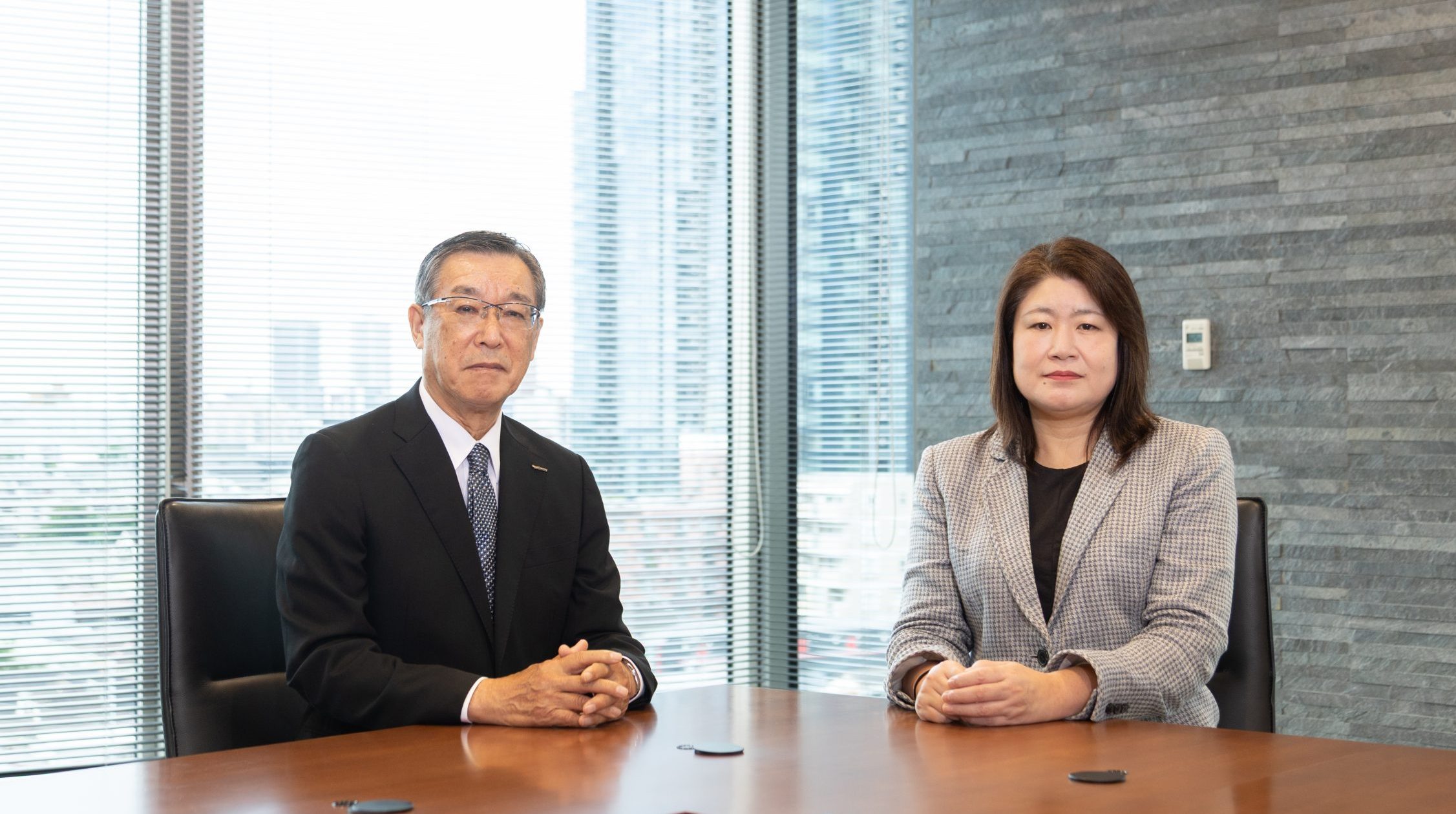
Right) Naoko Murasaki, External Director, Audit and Supervisory Committee Member
Fulfilling our responsibilities as External Directors to restore trust
Bringing Our Experience to Bear as External Directors
Katsukawa: I consider it my responsibility as an External Director to leverage the discerning eye for assessing the growth potential of businesses that I have honed through my involvement in the management of financial institutions and private equity funds. At Board of Directors meetings, I emphasize the perspective of working backward to determine what we should do now to enhance the Company’s corporate value five or ten years from now. I make a point of saying what needs to be said when it needs to be said and of making proposals that directly contribute to enhancing corporate value.
Murasaki: After serving at the National Police Agency, I developed expertise in risk management at a foreign-affiliated consulting firm. For this reason, I place particular emphasis on riskbased monitoring. The SEGA SAMMY Group does not believe in prioritizing profit at the expense of compliance. Its corporate culture respects diverse opinions and encourages frank discussion, so I feel the Board of Directors is also an environment where opinions can be expressed freely. Since I assumed my position in 2021, the risk and compliance management system has been further strengthened, with detailed reports made to the Board each quarter. I feel that this has ensured the transparency needed to enhance the effectiveness of our supervisory activities.
Katsukawa: It is precisely because such transparent information is provided that External Directors can speak frankly at Board meetings based on their respective areas of expertise. There have also been many instances where the executive team has sincerely taken on board our critical opinions as External Directors and responded promptly.
Enhancing the Effectiveness of M&A and Moving toward the Next Stage of Growth
Katsukawa: At the same time, we also take the impairment losses recognized for Rovio and Stakelogic in the fiscal year ended March 2026 very seriously. Before deciding to proceed with these acquisitions, we held extensive discussions at the Group Management Committee and other bodies, carefully considering the results of due diligence conducted by external consultants. However, we recognize that, in addition to changes in the market environment and business assumptions following the acquisitions, a major factor behind the impairment losses was that, in the case of Rovio, it took longer than anticipated to capitalize on synergies with the acquired company. From our supervisory position, we need to seriously examine the fact that we were unable to anticipate these acquisition risks and to encourage more multifaceted verification and take this into account in our future supervisory work. At the management camp in September 2025, we reviewed the processes for past M&A transactions, including recent large-scale transactions. I believe it is important to apply the lessons from this experience to future investment decisions and discussions at the Board meetings and the Group Management Committee.
Murasaki: We aimed to leverage Rovio’s expertise and technologies to grow and strengthen our mobile games business. As we began deploying them in our business following the acquisition, it became clear that the potential identified during due diligence differed from the conditions required for implementation and operation, revealing challenges that required further verification and adjustments. This M&A was intended not to enhance our strengths but to address our weaknesses, and we came to recognize that we needed a deeper understanding of the target company’s business and technologies to fully leverage its strengths.
This experience taught us a major lesson: the ability to overcome language and cultural barriers, together with practical post-merger integration (PMI) expertise, is indispensable when conducting M&A involving overseas companies, and we need to secure human capital with these skills. We must not let these impairment losses be in vain. After reviewing the entire process, we must ensure this experience leads to the success of our next investment.
Katsukawa: M&A is not the only area requiring our attention. With game development costs rising in recent years, in-house game development itself has come to entail enormous risk. Although we have delegated authority over game development to the respective companies and divisions, we have firmly put in place a mechanism to monitor progress through regular reports on title portfolios and other matters to the Group Management Committee.
Murasaki: In that respect, revising the inline process for confirming development progress several years ago was a major step forward. It has allowed us to detect warning signs such as development delays and cost overruns early, and a mechanism now operates effectively to share these issues promptly and discuss limits on development investment.
SEGA SAMMY’s Approach to Creativity in the AI Era
Murasaki: When considering the sustainable enhancement of corporate value going forward, the rapid evolution of generative AI is an unavoidable topic. While it offers opportunities to improve development efficiency, it also poses risks around copyright and reliability. We have established the Group AI Subcommittee and are considering appropriate ways to use generative AI, including formulating guidelines. I believe our proactive efforts to use it to improve the efficiency of indirect operations are also worthy of recognition.
Katsukawa: At the same time, I strongly support CEO Satomi’s policy of not using generative AI directly in the creative aspects of games and other content. Game creation is about providing captivating experiences to fans, and valuing uniquely human creativity helps build relationships of trust with our fans. This commitment to creativity has received strong support at the General Meeting of Shareholders, where many shareholders are also fans, and I hope the Group continues to value it as a way to enhance the Group’s brand value.
Murasaki: I understand that our development teams take pride in the belief that AI cannot create the kinds of worlds they can. Users are highly sensitive to the difference between works imbued with the spirit of their creators and AI-generated content, so this policy makes a great deal of sense to me. The Group has many sincere, passionate people who deeply love our products, and I believe the power of this human capital is nothing less than our most valuable management resource.
Katsukawa: I agree completely. At the same time, these outstanding intangible forms of value, including our human capital and brands, are not yet translating sufficiently into earnings, and I believe this has created a gap between our potential corporate value and our stock price. The Group has yet to achieve sufficient earnings power compared with our industry peers. What we do have, though, is a culture of valuing people that we have upheld since the Company’s founding. We also consistently rank highly among companies where students want to work, attracting outstanding human capital every year. To break free of our current constraints, creating an environment where these talented people can play an even greater role and fully demonstrate their capabilities is essential. Establishing this kind of environment would likely improve profitability and steadily close this gap. Combining the intangible assets of SEGA and Sammy is another important challenge. In that respect, I have great expectations that the Gaming Business, which bears the names of both companies, will gain global recognition under the SEGA SAMMY brand and grow into our third pillar.
Restoring the Trust of Our Shareholders
Katsukawa: Although we expect to fall short of the targets under the current medium-term plan, I have urged management to maintain their determination to get as close to those targets as possible right through to the very end. This is because if management shows even a hint of giving up, it will affect employee morale. Looking at each business separately, the Pachislot & Pachinko Machines Business maintains high profitability. If it can also achieve the top position in total utilization share, our most important indicator, it will become an overwhelming presence leading the industry. The Entertainment Contents Business also has limitless revenue growth potential if it can make even more effective use of SEGA’s extensive portfolio of world-class IPs. As we unlock the potential of these business divisions, I expect the Group as a whole, including the corporate divisions, to pursue greater efficiency and evolve into a stronger SEGA SAMMY.
Murasaki: Looking toward the next medium-term plan, restoring trust in the near term is our highest priority. We must restore shareholders’ confidence in the Group’s M&A activities by putting the three companies we acquired—Rovio, Stakelogic, and GAN—on a solid footing as quickly as possible. In formulating the next medium-term plan, I intend to rigorously examine not only the path toward restoring confidence in our M&A but also the feasibility of the medium-term plan as a whole.
Katsukawa: Against a backdrop of rapid technological advances, the landscape surrounding the entertainment industry is changing at an unimaginable pace. While we need to improve the plan’s feasibility, building the next medium-term plan by simply extending the current one will not be sufficient to respond to these dizzying changes. For the SEGA SAMMY Group to survive as a truly strong player in this new era, we need to break out of our existing mold and formulate a new plan with the firm resolve to reinvent ourselves. I intend to maintain a rigorous supervisory stance to help build a truly strong Group.
*This article is excerpted from the INTEGTARED Report 2026.